What Is Andropause — and Is It Happening to You?
You don’t feel like yourself anymore, and you’ve told yourself it’s just age. It might be andropause.
Most men don’t walk into my office asking about andropause. They come in describing a list of things that don’t add up on their own — less energy, less interest in sex, a harder time losing the weight around the middle, a shorter fuse, a foggier head. Individually, each symptom gets blamed on something else: work stress, poor sleep, “just getting older.” Together, they often point to one underlying process: the gradual decline in testosterone that begins in a man’s 30s and continues, often unaddressed, for decades.
The reason so few men recognize it is that andropause doesn’t arrive as an event. There’s no single day it starts, no clear before-and-after the way there sometimes is with an acute illness. It accumulates quietly enough that many men adjust their expectations for what “normal” feels like well before they ever consider that something treatable is happening.
What andropause actually is
Andropause refers to the age-related decline in testosterone production in men, sometimes called “male menopause” — though that term is a useful shorthand more than a precise medical parallel. Female menopause involves a relatively abrupt drop in estrogen over a defined window, with a clear endpoint. Andropause is different: testosterone declines gradually, there is no defined endpoint, and the pace and severity vary considerably from one man to the next. Some men experience a slow decline that never becomes clinically significant. Others develop levels low enough to produce real, treatable symptoms.
When it starts and how it progresses
Testosterone production typically peaks in a man’s late 20s and begins a slow decline afterward — commonly cited at roughly 1 to 2 percent per year starting in the 30s. That rate sounds negligible in any single year, which is exactly why it goes unnoticed. But compounded over two or three decades, that decline becomes substantial. A man in his 50s may have meaningfully lower testosterone than he did at 30, even without any distinct illness — and the cumulative symptom burden by that point is often what finally brings him in for an evaluation.
The symptoms — physical, sexual, psychological, cognitive
Andropause symptoms cluster into four broad categories:
- Physical: persistent fatigue, reduced muscle mass, increased abdominal fat, reduced bone density over time
- Sexual: lower libido, erectile changes, reduced morning erections
- Psychological: low mood, irritability, reduced motivation
- Cognitive: brain fog, difficulty concentrating, slower recall
No single symptom confirms andropause on its own — each one has other possible causes. It’s the combination, evaluated alongside lab work, that points toward a hormonal explanation. Individual results vary, and a proper diagnosis requires testing, not just a symptom checklist.
What causes andropause beyond age
Age is the baseline driver, but several conditions accelerate the decline meaningfully:
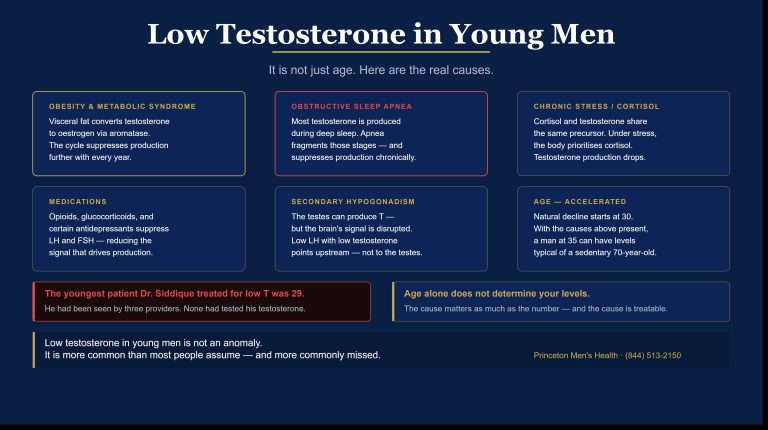
- Obesity, particularly visceral fat, which actively converts testosterone to estrogen and suppresses natural production — this connection is explored further on the men’s weight loss page
- Untreated sleep apnea, which disrupts the deep sleep stages where testosterone production is concentrated — see sleep and men’s health
- Chronic stress and elevated cortisol, which suppress the hormonal signaling pathway that drives testosterone production
- Certain medications, including some used for chronic pain and mood disorders
These accelerators are also why two men of the same age can have very different testosterone levels — age sets the trajectory, but these factors determine how steep the decline actually is.
How andropause is diagnosed
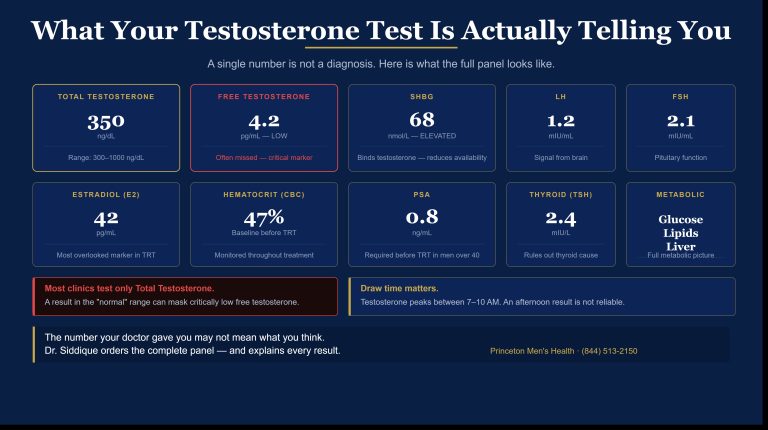
This is where “your levels are normal” becomes a problem. A single total testosterone value, drawn at the wrong time of day, without free testosterone or SHBG, frequently misses a genuine deficiency. A complete evaluation includes a morning total and free testosterone level, SHBG, LH, FSH, and estradiol, confirmed on a second occasion. Learn what a testosterone blood test should include for a full picture.
What treatment looks like
When testosterone deficiency is confirmed and symptomatic, testosterone replacement therapy is the primary medical treatment, with dosing adjusted based on follow-up labs and symptom response rather than a fixed starting dose. Lifestyle factors — weight management, sleep quality, and stress reduction — support treatment but rarely reverse a genuine deficiency on their own, particularly once the decline has progressed. Individual results vary, and the right combination depends on what’s actually driving your specific case.
Is andropause the same as low testosterone?
Yes. “Andropause” and “low testosterone” describe the same underlying condition — the term simply frames it as the gradual, age-related process it usually is, rather than a single lab abnormality. Whichever term brought you here, the evaluation and treatment approach is the same.
A closer look, not a resignation to aging
If you’ve noticed yourself feeling like a duller version of who you used to be and have written it off as simply getting older, it may be worth a closer look. I evaluate men from Lawrence Township, Hamilton, and West Windsor for exactly this kind of gradual hormonal change, often after they’ve searched for a TRT clinic near me. Contact Princeton Men’s Health to schedule a complete hormonal evaluation.
Frequently Asked Questions
What is andropause?
Andropause is the gradual, age-related decline in testosterone production in men, sometimes called “male menopause.” Unlike female menopause, it has no defined endpoint and progresses slowly, with the pace and severity varying significantly between individuals.
What age does andropause start?
Testosterone production typically peaks in the late 20s and begins declining afterward, commonly cited at roughly 1 to 2 percent per year starting in the 30s. The decline is gradual enough in any given year to go unnoticed, but it becomes cumulatively significant by a man’s 40s and 50s.
What are the symptoms of andropause?
Symptoms span physical changes (fatigue, reduced muscle mass, increased abdominal fat), sexual changes (lower libido, erectile changes), psychological changes (low mood, irritability), and cognitive changes (brain fog, difficulty concentrating). No single symptom confirms the diagnosis on its own — a combination, along with lab testing, points toward andropause.
Is andropause the same as low testosterone?
Yes. Andropause and low testosterone describe the same underlying hormonal condition. “Andropause” emphasizes the gradual, age-related nature of the decline, while “low testosterone” refers to the clinical finding itself.
Can andropause be treated?
Yes, when testosterone deficiency is confirmed through appropriate lab testing and is producing symptoms, testosterone replacement therapy is the primary medical treatment, supported by lifestyle factors such as weight management, sleep quality, and stress reduction. Individual results vary based on the underlying cause and severity.
How do I know if I have andropause?
The only reliable way to know is a complete hormonal evaluation — a morning blood draw measuring total and free testosterone, SHBG, LH, FSH, and estradiol, confirmed on a second occasion. Contact Princeton Men’s Health to schedule an evaluation if you recognize the symptoms described above.