Why Your Testosterone Is Low at 38 — It’s Not Just Age
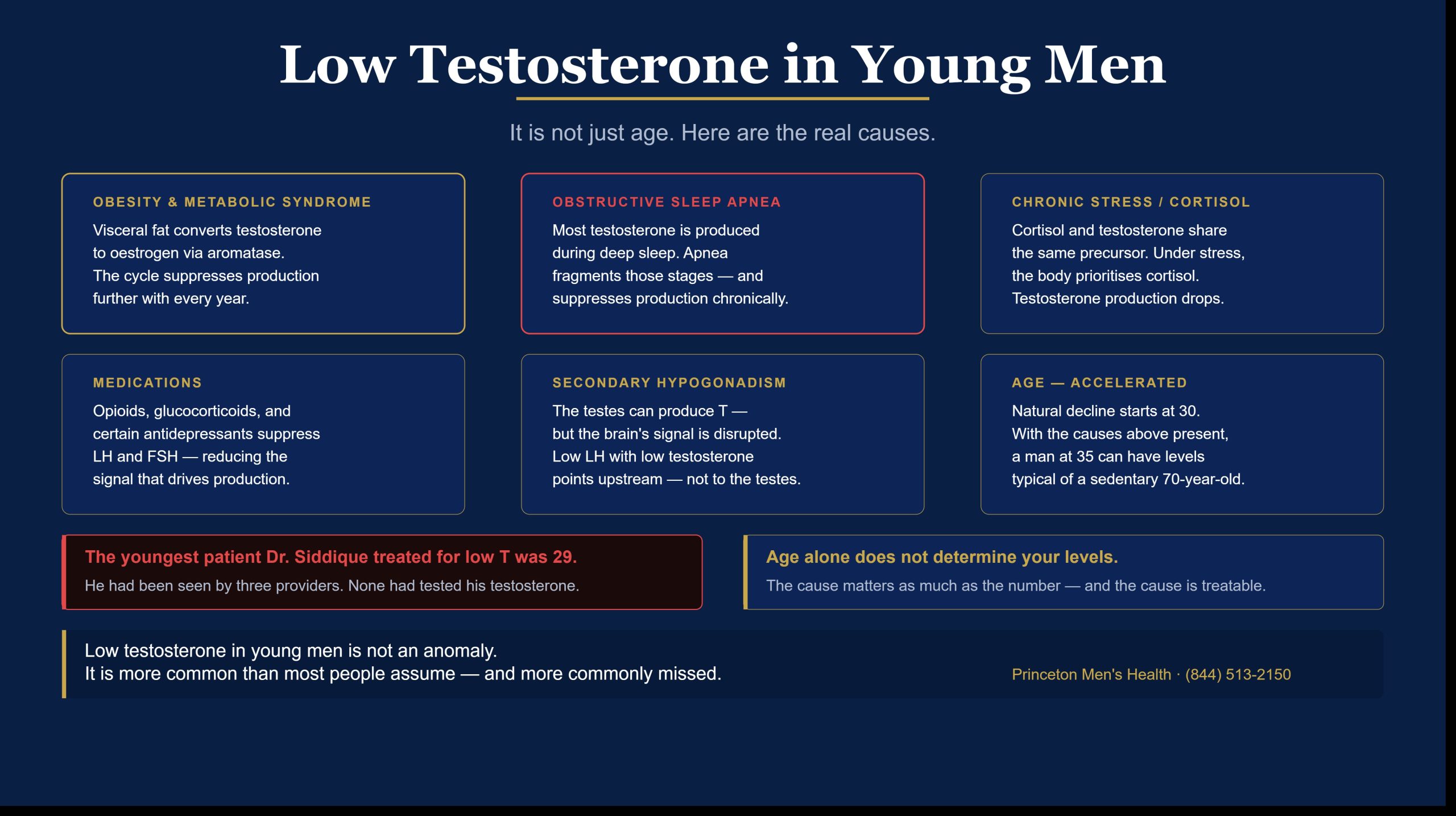
The Youngest Patient I Ever Treated for Low Testosterone Was 29
In younger men especially, low testosterone is often secondary rather than primary — meaning the testes are capable of producing testosterone but are not receiving the correct signal from the brain.
He had never had it tested. Neither had any of the three providers who had seen him in the previous two years.
Low testosterone in young men is not an anomaly — it is more common than most people assume, and more commonly missed. It never was. But the assumption that it is — that you have to be in your 60s before your levels matter — is causing a significant number of younger men to go undiagnosed for years while they are told their symptoms are stress, lifestyle, or attitude.
The textbook answer is that testosterone begins declining at around age 30, falling approximately 2% per year. By the time a man reaches his mid-40s, the cumulative effect becomes measurable. By 60, many men have lost 25% or more of their peak production.
Why Testosterone Starts Declining Earlier Than Most Men Expect
If you are in your 30s or 40s and you do not feel like yourself, this article is for you.
That is the natural trajectory. But natural does not mean inevitable, and it does not mean you have to wait until 60 to feel it.
What the textbook does not always emphasise is how dramatically that decline can be accelerated — by conditions that are increasingly common in men in their 30s and 40s. Obesity. Sleep apnea. Metabolic syndrome. Chronic stress. Certain medications. In men with these conditions, testosterone does not drift downward gradually. It drops.
I see men in their mid-30s with testosterone levels I would expect in a sedentary 70-year-old. The age on their chart does not predict the number on their lab report.
The Real Causes of Low T in Younger Men
Obesity and Metabolic Syndrome
Adipose tissue — body fat, particularly visceral fat around the abdomen — contains an enzyme called aromatase. Aromatase converts testosterone into oestrogen. The more visceral fat a man carries, the more testosterone is being converted into oestrogen rather than remaining available as testosterone.
This is a self-reinforcing cycle. Low testosterone promotes fat accumulation. Fat accumulation further suppresses testosterone. Without intervention, the cycle does not correct itself.
Metabolic syndrome — the cluster of high blood pressure, elevated blood sugar, high triglycerides, low HDL, and abdominal obesity — is now present in roughly one in three American adults. It is one of the strongest predictors of low testosterone I see in my clinic, in men of any age.
Obstructive Sleep Apnea
The majority of testosterone production occurs during sleep, specifically during the deep sleep stages. Obstructive sleep apnea fragments those sleep stages repeatedly throughout the night. Each apnea event interrupts the architecture of sleep. Over months and years, this chronically suppresses testosterone production at the source.
This is the one most men — and many physicians — do not connect to testosterone.
I am board-certified in sleep medicine. In my experience, untreated sleep apnea is one of the most underdiagnosed contributors to low testosterone in men under 50. I have had patients whose testosterone normalised significantly after their sleep apnea was treated — without any hormone therapy at all.
If you have low testosterone and you snore, wake unrefreshed, or have been told you stop breathing at night, the sleep apnea needs to be evaluated before or alongside any TRT discussion.
Chronic Stress and Elevated Cortisol
The relationship between cortisol and testosterone is direct and well-established. Cortisol — the primary stress hormone — and testosterone are both produced from the same precursor. Under chronic stress, the body prioritises cortisol production. Testosterone production is suppressed as a consequence.
This is not a psychological explanation for a hormonal problem. It is a hormonal explanation for a hormonal problem. Chronic workplace stress, poor sleep, and unrelenting pressure do not just make you feel worse — they alter your endocrine function at a measurable level.
Medications
Several commonly prescribed medications suppress testosterone production or interfere with its action. Opioid pain medications are among the most significant — chronic opioid use suppresses LH and FSH, reducing the signal that drives testosterone production. Long-term opioid users frequently develop secondary hypogonadism as a direct consequence.
Other medications worth noting include certain antidepressants, glucocorticoids (steroids prescribed for inflammatory conditions), and some blood pressure medications. If you are on any of these and have symptoms of low testosterone, the medication history needs to be part of the conversation.
Secondary Hypogonadism
He had been told he was anxious. That he was depressed. That he was working too hard and not sleeping enough. All of those things may have been true. But the reason he sat across from me exhausted, unmotivated, and completely disinterested in sex at 29 years old was that his testosterone was 187 ng/dL.
The pituitary gland releases luteinising hormone (LH), which tells the testes to produce testosterone. If LH is low or inappropriately normal in the context of low testosterone, the problem is upstream — in the pituitary or hypothalamus. Causes include elevated prolactin, pituitary abnormalities, haemochromatosis, and the conditions listed above.
This distinction matters because it changes the treatment approach. A 35-year-old with secondary hypogonadism driven by sleep apnea and obesity needs a different conversation than a 35-year-old with primary testicular failure.
Signs of Low Testosterone in Young Men
Younger men with low testosterone rarely come in saying “I think my testosterone is low.” They come in saying they are exhausted. That they have no drive at work or at the gym. That their relationship is suffering because their libido has disappeared. That they are gaining weight despite not eating differently. That they feel flat — not quite depressed, but not themselves.
These are the presentations I see most often in men under 45:
None of these symptoms alone confirms low testosterone. All of them together, in a man under 50, should prompt a proper hormonal evaluation.
What a Proper Evaluation Looks Like for a Younger Man
The workup for a younger man with suspected low testosterone is more thorough than for an older man, not less. Because the causes are more varied and the stakes of missing something are higher — a 35-year-old with untreated secondary hypogonadism has decades ahead of him.
- Persistent fatigue — not tiredness that sleep fixes, but a baseline exhaustion that has become the new normal
- Loss of motivation and drive — at work, in the gym, in relationships
- Declining libido — often the first symptom noticed by partners before the man himself acknowledges it
- Difficulty building or maintaining muscle — despite consistent training
- Increased body fat — particularly around the abdomen, without significant dietary changes
- Brain fog — difficulty concentrating, slower recall, reduced sharpness
- Mood changes — irritability, low mood, emotional flatness
- Poor sleep quality — difficulty staying asleep, non-restorative sleep
A Note on Fertility
One question younger men ask that older men rarely do: will TRT affect my fertility?
The answer is yes — exogenous testosterone suppresses the body’s own production of LH and FSH, which are necessary for sperm production. Men on TRT typically experience a significant reduction in sperm count, which is reversible in most cases after discontinuing therapy but is not guaranteed.
For younger men who may want children in the future, this conversation needs to happen before treatment begins. There are alternative approaches — medications that stimulate the body’s own testosterone production rather than replacing it externally — that preserve fertility while addressing symptoms. These are not appropriate for every patient, but they are worth discussing.
I raise this not to discourage treatment but to ensure the decision is fully informed.
Starting the Conversation
If you are under 50 and you recognise yourself in this article, the first step is not a prescription. It is a conversation and a proper blood panel.
If your evaluation confirms low testosterone, testosterone replacement therapy is one of several options Dr. Siddique will discuss based on your age, goals, and clinical picture.
Princeton Men’s Health is located at 31 East Darrah Lane in Lawrence Township, New Jersey — minutes from Princeton, Hamilton, West Windsor, and the surrounding Mercer County area. Every evaluation starts with a thorough workup. Every treatment plan accounts for your age, your goals, and your full clinical picture.
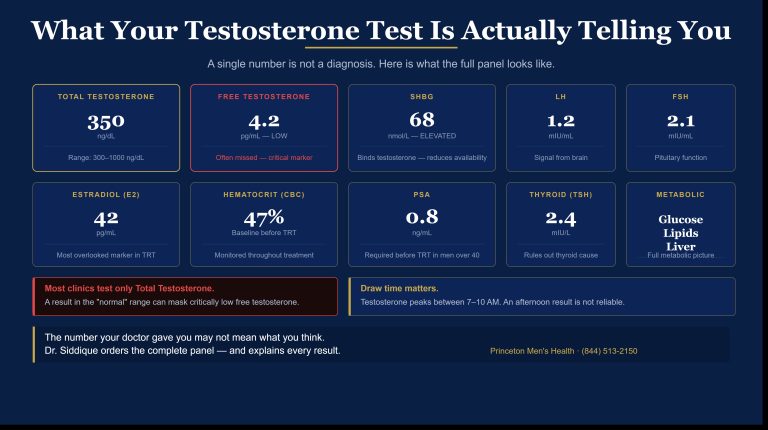
At minimum I want to see total testosterone, free testosterone, SHBG, LH, FSH, estradiol, prolactin, a complete blood count, a comprehensive metabolic panel, thyroid function, and a PSA baseline. In men with significant obesity or metabolic syndrome I also look at insulin resistance markers. In men with symptoms of sleep disruption I order a sleep study.
This is not a panel you will get from a telehealth TRT service that turns around a prescription in 48 hours. It is the panel that gives me the information I need to treat the cause, not just the number.
Frequently asked questions
Yes — and it is more common than most men realise. While testosterone naturally begins declining around age 30, several conditions can accelerate that decline significantly in younger men: obesity, obstructive sleep apnea, metabolic syndrome, chronic stress, and certain medications. I regularly see men in their mid-30s with testosterone levels typically associated with men decades older. Age alone does not determine your levels.
The most common causes I see in younger men are obesity and visceral fat (which converts testosterone to oestrogen via aromatase), obstructive sleep apnea (which disrupts the deep sleep stages where most testosterone is produced), chronic stress and elevated cortisol, certain medications including opioids and glucocorticoids, and secondary hypogonadism — where the brain’s signal to the testes is disrupted rather than the testes themselves failing.
The most common presentations I see in younger men are persistent fatigue that sleep does not resolve, loss of motivation and drive, declining libido, difficulty building muscle despite consistent training, increasing abdominal fat, brain fog, mood changes including irritability and emotional flatness, and poor sleep quality. These symptoms are frequently attributed to stress or lifestyle — which delays proper diagnosis by months or years.
Yes — this is an important conversation for younger men. Exogenous testosterone suppresses the body’s own LH and FSH production, which are necessary for sperm production. Most men experience a significant reduction in sperm count while on TRT, which is reversible in most cases after stopping but is not guaranteed. For men who may want children, there are alternative approaches that stimulate the body’s own testosterone production while preserving fertility. This discussion should happen before any treatment decision is made.
Yes — and identifying and addressing the underlying cause is as important as the hormone replacement itself. In men whose low testosterone is driven by untreated sleep apnea, treating the sleep apnea sometimes normalises testosterone without any hormone therapy. In men with obesity-related suppression, metabolic improvements can meaningfully raise levels. Where TRT is appropriate, it is highly effective when properly prescribed and monitored by a physician with experience managing younger patients.
Princeton Men’s Health provides comprehensive hormonal evaluations at our clinic in Lawrence Township — minutes from Princeton, Hamilton, West Windsor, and the wider Mercer County area. For younger men I order a full panel including LH, FSH, prolactin, and thyroid function in addition to the standard testosterone markers, because the cause matters as much as the number. Call (844) 513-2150 or book online to schedule with Dr. Siddique.