What a Testosterone Blood Test Actually Tells Me — and What It Doesn’t
Testosterone / Men’s Health
What a Testosterone Blood Test Actually Tells Me — and What It Doesn’t
Dr. Mahmood Siddique explains what a complete hormonal panel includes — and why most men are tested incompletely.
By Dr. Mahmood Siddique, DO, FACP, FCCP, FAASM — Board-Certified in Internal Medicine, Pulmonary Medicine, Critical Care, and Sleep Medicine. Clinical Associate Professor, Rutgers Robert Wood Johnson Medical School.
The Number Your Doctor Gave You May Not Mean What You Think
Every week I see men who have been told their testosterone is normal. Some of them have been told this two or three times, by two or three different providers. And yet they sit across from me exhausted, foggy, disinterested in sex, and quietly convinced that something is wrong.
Most of the time, they are right.
The problem is rarely that testosterone was not tested. The problem is that it was tested incompletely — a single number drawn at the wrong time of day, interpreted against a reference range so wide it includes men who feel perfectly well and men who feel terrible, with no additional context.
If you are searching for a testosterone test near you in New Jersey, the most important thing I can tell you is this: the test itself is only as useful as the panel it sits in, and the panel is only as useful as the physician interpreting it.
Why Timing Matters Before the Blood Is Even Drawn
Testosterone is not a flat line. It follows a diurnal rhythm — meaning it rises and falls across the day in a predictable pattern. In most men, levels are highest in the early morning, typically between 7 and 10 AM, and lowest in the late afternoon and evening.
A testosterone reading taken at 2 PM on a man who is genuinely low can look deceptively normal. The same man tested at 8 AM might show a significantly different result.
In my practice, I always draw testosterone in the morning, on at least two separate occasions before making a diagnosis. A single afternoon result is not a diagnosis — it is a data point, and not a particularly reliable one.
This is standard practice in endocrinology. It is not universally followed in primary care or in many men’s health clinics that prioritise convenience over accuracy.
Total Testosterone — What It Measures and What It Misses
Total testosterone is the number most commonly reported. It measures all of the testosterone circulating in your blood — both the portion that is bound to proteins and the smaller portion that is free and biologically active.
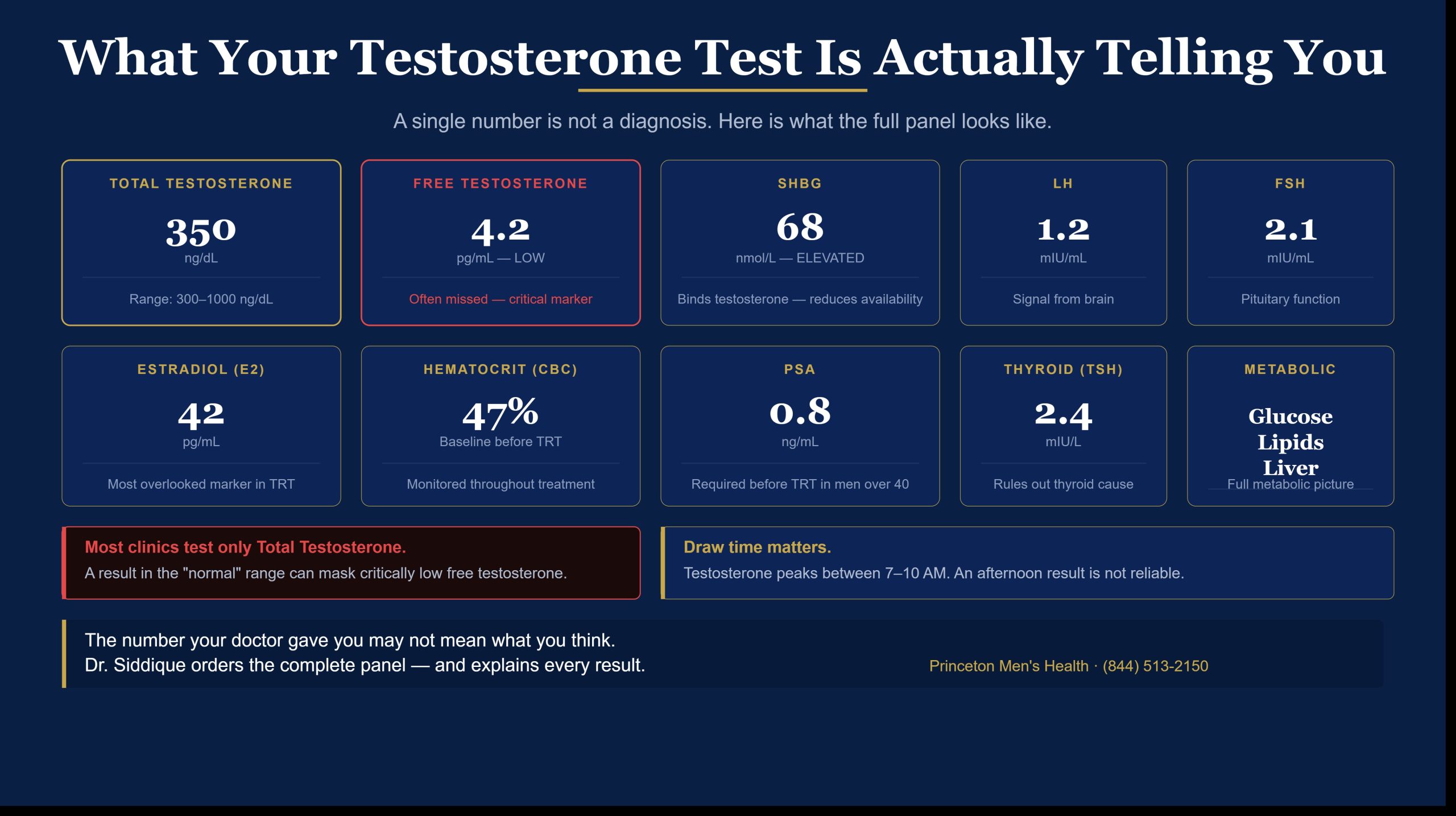
The standard reference range in most laboratory reports runs from approximately 300 to 1000 ng/dL, with some labs setting the lower threshold as low as 264 ng/dL. This is an enormous range. A man at 310 ng/dL and a man at 950 ng/dL are both technically “normal” — but they are not in the same physiological condition, and they will not feel the same way.
The lower boundary of that range was largely derived from population studies that included elderly men and men with chronic illness. Using it as the sole benchmark for a 45-year-old who feels like he is running on empty is, in my view, a clinical shortcut.
I use total testosterone as a starting point. Not a conclusion.
Free Testosterone — The Number That Often Changes Everything
Here is what many men are never told: most of the testosterone in your blood is not actually available for your body to use.
Approximately 60% is tightly bound to a protein called sex hormone-binding globulin (SHBG). Another 38% is loosely bound to albumin. Only around 2% circulates as free testosterone — unbound, biologically active, and available to your tissues.
In men with high SHBG — which becomes more common with age, liver conditions, thyroid issues, and certain medications — total testosterone can look perfectly normal while free testosterone is critically low. These men have adequate hormone on paper and inadequate hormone in practice.
Free testosterone is not routinely ordered in many primary care settings. In my evaluation it is non-negotiable.
If your previous testosterone test did not include free testosterone and SHBG, you do not yet have a complete picture.
LH and FSH — Understanding Why Your Testosterone Is Low
Total and free testosterone tell me how much testosterone you have. LH and FSH tell me why.
Luteinising hormone (LH) is released by the pituitary gland and signals the testes to produce testosterone. Follicle-stimulating hormone (FSH) is involved in sperm production. Together they tell me where in the hormonal chain the problem originates.
If your testosterone is low and your LH is high, your pituitary is working correctly — it is sending the signal, but the testes are not responding. This is primary hypogonadism.
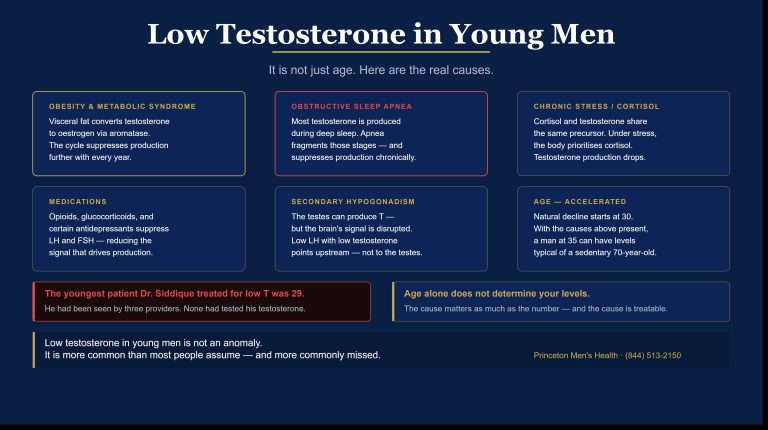
If your testosterone is low and your LH is also low or inappropriately normal, the problem is higher up — in the pituitary or hypothalamus. This is secondary hypogonadism, and it changes the diagnostic picture considerably. Secondary hypogonadism in a younger man warrants investigation for causes including sleep apnea, elevated prolactin, or a pituitary abnormality.
These distinctions determine treatment. They are also routinely missed when testosterone is the only thing tested.
Estradiol — The Most Overlooked Marker in TRT
Testosterone converts to estrogen through a process called aromatisation. In men, estradiol — the primary form of oestrogen — plays important roles in bone density, libido, cardiovascular health, and mood. Too little is a problem. Too much is also a problem.
When testosterone is elevated — whether through natural production or replacement therapy — estradiol can rise with it. Elevated estradiol in men causes fatigue, water retention, mood instability, reduced libido, and erectile difficulty. These are, of course, the same symptoms men start TRT to resolve.
I routinely check estradiol before initiating any testosterone therapy. I continue checking it throughout treatment. Estradiol management is one of the most clinically important and most commonly neglected aspects of TRT — and in my experience, it is the single most frequent explanation for why a man on TRT still does not feel well.
Frequently Asked Questions
A proper testosterone evaluation should include total testosterone, free testosterone, SHBG, LH, FSH, estradiol, a complete blood count, PSA (in men over 40), and a comprehensive metabolic panel. A single total testosterone number drawn without this context gives an incomplete picture and can lead to missed diagnoses in both directions.
Testosterone follows a diurnal rhythm and is highest in the early morning, typically between 7 and 10 AM. Testing outside this window — particularly in the afternoon or evening — can produce results that appear higher than your true baseline. I always draw testosterone in the morning, on at least two separate occasions before making a diagnosis.
Free testosterone is the biologically active portion of testosterone that your body can actually use. Most testosterone in the blood is bound to proteins — primarily SHBG — and is not available to your tissues. Men with high SHBG can have normal total testosterone but critically low free testosterone, which means their symptoms are real even when the standard number looks fine.
This is one of the most common situations I encounter. “Normal” on a standard lab range does not mean optimal for you as an individual. If you have classic low-T symptoms — fatigue, low libido, brain fog, mood changes, loss of muscle — and have been told your levels are normal based on a single total testosterone reading, I would encourage a more complete evaluation that includes free testosterone, SHBG, LH, FSH, and estradiol before concluding that testosterone is not the issue.
Princeton Men’s Health provides full hormonal panels at our clinic in Lawrence Township, New Jersey — minutes from Princeton, Hamilton, West Windsor, and the wider Mercer County area. We draw under morning conditions, interpret in full clinical context, and never base a diagnosis on a single number. Call (844) 513-2150 or book online to schedule your evaluation with Dr. Siddique.
Coverage varies by plan and by the clinical indication documented at the time of the test. Many insurance plans cover testosterone testing when ordered for evaluation of symptoms consistent with hypogonadism. At Princeton Men’s Health we are transparent about pricing — call our office at (844) 513-2150 and we will give you a clear answer before you come in.
What Else I Check Before Starting TRT
- Complete blood count (CBC) — Testosterone stimulates the bone marrow to produce red blood cells. Before treatment begins, I need to know your baseline hematocrit. If it is already elevated, that changes how we approach dosing and monitoring. Elevated hematocrit increases blood viscosity and cardiovascular risk — it is manageable, but only if we are watching for it.
- PSA (prostate-specific antigen) — Standard screening before initiating TRT in men over 40. Testosterone does not cause prostate cancer, but it can accelerate the growth of existing cancer. A baseline PSA establishes a reference point and flags any pre-existing concerns before we begin.
- Comprehensive metabolic panel — Liver function, kidney function, fasting glucose, and lipid markers. Low testosterone is closely associated with metabolic syndrome, insulin resistance, and obesity. Understanding the metabolic picture before treatment helps me personalise the approach and track improvements over time.
- Thyroid function — Not always included in standard TRT evaluations, but worth checking. Hypothyroidism produces symptoms nearly identical to low testosterone — fatigue, weight gain, low libido, depression, cognitive slowing. A man treated for low T when the real problem is an underactive thyroid will not improve.
What “Normal” Actually Means
When a lab report comes back and says your testosterone is within the normal range, what it is actually telling you is that your level falls within the range observed in a large sample of men of varying ages and health statuses.
It is not telling you that your level is optimal for you. It is not telling you that your symptoms are not caused by low testosterone. It is not telling you that treatment would not help.
In my nearly 30 years of practice, I have treated many men whose testosterone sat comfortably in the low-normal range — 350 to 450 ng/dL — who had every classic symptom of testosterone deficiency and responded dramatically to treatment. I have also counselled men with levels in that same range who felt entirely well and did not need intervention.
The number matters. The context matters more.
Getting Tested at Princeton Men’s Health
If you are looking for a testosterone test near you in New Jersey, Princeton Men’s Health offers a comprehensive hormonal evaluation — not a single-marker screen.
At our clinic in Lawrence Township — minutes from Princeton, Hamilton, West Windsor, and the surrounding Mercer County area — every evaluation begins with a full panel drawn under appropriate conditions, interpreted by a physician with nearly 30 years of clinical experience who takes a comprehensive approach to testosterone replacement therapy.
If you have been tested before and told your levels are normal, but you still do not feel like yourself — that conversation deserves a more complete answer.
Not sure where to begin? Read our guide to finding a TRT clinic near you in New Jersey.

ABOUT THE AUTHOR
Dr. Mahmood Siddique, DO, FACP, FCCP, FAASM
Board-Certified in Internal Medicine, Pulmonary Medicine, Critical Care, and Sleep Medicine. Clinical Associate Professor, Rutgers Robert Wood Johnson Medical School. In nearly 30 years of practice, Dr. Siddique has evaluated and treated thousands of men for hormonal and metabolic health concerns.