Signs of Low Testosterone in Men
He came in for a knee injury follow-up. He left with a testosterone test ordered — and a diagnosis he didn’t expect.
A patient came to see me a while back for something unrelated to hormones entirely — a lingering issue after a minor injury. Partway through the visit, almost as an aside, he mentioned that he’d been exhausted for months, had lost interest in things he used to enjoy, and assumed it was just the stress of a demanding year. That offhand comment was the reason I ordered a testosterone panel. It came back low. He wasn’t looking for that diagnosis, but once we found it, most of what he’d written off as burnout made a lot more sense.
I share that story because it’s common. Low testosterone rarely announces itself. It shows up as a collection of vague, easy-to-explain-away symptoms that men attribute to aging, work stress, poor sleep, or simply “having an off year.” Recognizing the pattern — and knowing when it’s worth a blood test — is the first step toward an actual answer.
Why low testosterone is so frequently missed
Three things work against early recognition. First, the symptoms overlap heavily with normal life stress, aging, and other common conditions, so there’s rarely one obvious red flag. Second, testosterone testing isn’t part of a routine annual physical unless a patient specifically raises it. Third, even when men do notice something is off, many assume — incorrectly — that low testosterone only causes low libido, so they don’t connect their fatigue, mood changes, or difficulty losing weight to a possible hormonal cause.
The 9 most common signs
Each of these has other possible explanations on its own, but together they build a pattern worth investigating:
- Persistent fatigue. Testosterone plays a role in energy metabolism and red blood cell production; low levels can produce a tiredness that doesn’t resolve with rest or sleep.
- Low libido. Testosterone is a primary driver of sexual desire; a persistent, unexplained drop in interest is one of the more specific signs, though not universal.
- Erectile dysfunction. Testosterone supports the vascular and neurological pathways involved in achieving and maintaining erections; when erectile dysfunction appears alongside other symptoms on this list, it raises the likelihood of a hormonal contributor.
- Loss of muscle mass. Testosterone supports protein synthesis and muscle maintenance; a noticeable decline in strength or muscle tone despite consistent activity levels can signal a hormonal shift.
- Increased body fat, especially abdominal. Lower testosterone is associated with a shift in fat distribution toward the abdomen, and abdominal fat in turn suppresses testosterone further, creating a self-reinforcing cycle. See men’s weight loss.
- Depression and mood changes. Testosterone influences neurotransmitter systems tied to mood regulation; low levels are associated with irritability, low mood, and reduced motivation.
- Brain fog and poor concentration. Some men describe a subtle decline in mental sharpness and word recall that they attribute to normal aging but that improves with hormonal correction in appropriate candidates.
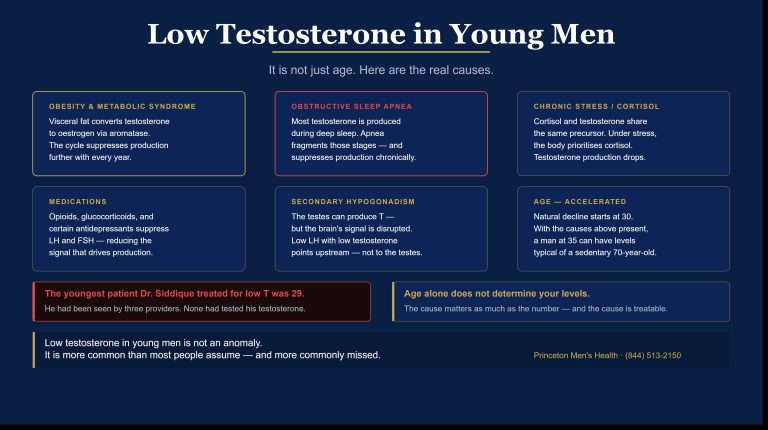
- Poor sleep quality. The relationship runs both directions: low testosterone can disrupt sleep architecture, and poor sleep — particularly untreated sleep apnea — further suppresses testosterone production. See sleep and men’s health.
- Reduced motivation and drive. A general decline in ambition, competitiveness, or interest in previously engaging activities is a symptom patients often describe but rarely connect to hormones on their own.
Which combinations are most telling
No single symptom on this list is diagnostic on its own — each has other common causes. What tends to be more clinically significant is a cluster: fatigue plus reduced libido plus loss of muscle mass, for example, or depression plus poor sleep plus reduced motivation. When three or more of these symptoms appear together, particularly in a man over 30, it’s a reasonable point to request testing rather than continue attributing each symptom to something separate.
What symptoms alone cannot tell you
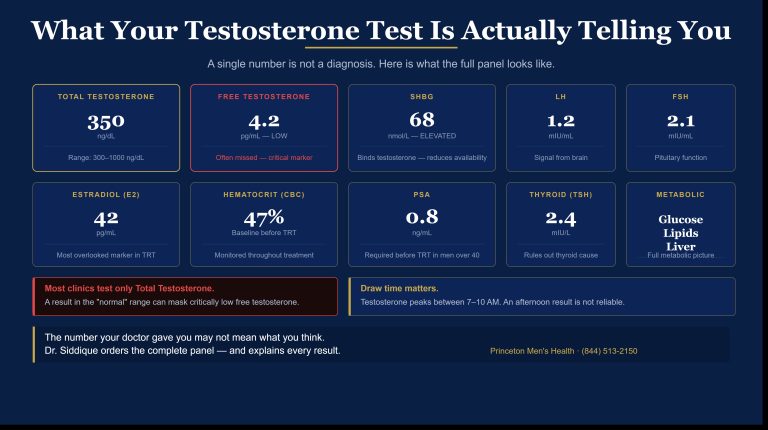
Symptoms can point toward low testosterone, but they cannot confirm it, and they certainly cannot tell you how to treat it. Depression, sleep apnea, thyroid dysfunction, and chronic stress can all produce a nearly identical symptom picture without any hormonal deficiency at all. The only way to know for certain is a complete blood panel — total and free testosterone, done correctly — because a single total testosterone value can also miss a genuine deficiency, as I’ve written about in more detail on the low testosterone NJ page.
The connection between low T and other conditions
Low testosterone rarely exists in isolation. It’s frequently connected to sleep apnea, which suppresses testosterone production directly through disrupted deep sleep; to metabolic syndrome, since insulin resistance and low testosterone reinforce one another; and to depression, since the symptom overlap between the two conditions means each can mask or mimic the other. This is part of why a complete evaluation looks beyond testosterone alone to the broader metabolic and sleep picture.
What to do if you recognize these signs
If several of these symptoms sound familiar, the next step is testing — not guessing. Testosterone replacement therapy is only appropriate once a deficiency is confirmed through proper lab work, and even then, treatment is built around your specific levels and symptoms rather than a standard protocol. Individual results vary, and the first step is always an accurate diagnosis.
If this list described more of your last six months than you’d like
It’s worth a conversation. I evaluate men from Lawrence Township, Hamilton, and West Windsor, many of whom started exactly where you are now — searching for a TRT clinic near me after recognizing this pattern in themselves. Contact Princeton Men’s Health to schedule a complete evaluation.
Frequently Asked Questions
What are the first signs of low testosterone?
The earliest signs are often subtle: persistent fatigue, a decline in motivation, and a gradual drop in libido. These are easy to attribute to stress or normal aging, which is why low testosterone is frequently missed in its earlier stages.
Can low testosterone cause depression?
Yes. Testosterone influences neurotransmitter systems involved in mood regulation, and low levels are associated with low mood, irritability, and reduced motivation. Depression and low testosterone can also coexist and reinforce one another, which is why a complete evaluation looks at both.
How do I know if my symptoms are from low testosterone or something else?
You can’t know from symptoms alone — conditions like sleep apnea, thyroid dysfunction, depression, and chronic stress can produce a very similar symptom picture. A complete blood panel measuring total and free testosterone, along with related markers, is the only reliable way to determine the cause.
What is the most common symptom of low testosterone?
Persistent fatigue and reduced libido are among the most commonly reported symptoms, but no single symptom is universal or definitive on its own. It’s typically a combination of symptoms, confirmed with lab testing, that points toward a diagnosis.
Can you have low testosterone symptoms with normal blood test results?
Yes, particularly if the testing was incomplete. A single total testosterone value, drawn at the wrong time of day without free testosterone or SHBG, can appear “normal” while still missing a genuine deficiency. A complete panel is necessary for an accurate answer.
Where can I get tested for low testosterone in New Jersey?
Contact Princeton Men’s Health to schedule a complete hormonal evaluation, including a full panel rather than a single lab value. Call (844) 513-2150 or use the contact form to get started.