Low Testosterone NJ — Diagnosis and Treatment
You’ve had blood work done. Your doctor said your testosterone was “normal.” Here’s what that word is hiding.
I hear a version of this sentence several times a week: “I already got tested, and my doctor said I was fine.” When I ask what test was run, the answer is almost always the same — a single total testosterone level, drawn at some point during the day, compared against a reference range that was never designed to identify who benefits from treatment. That single data point is often the entire reason a man in New Jersey walks around undiagnosed for years.
This isn’t a failure of effort on the part of primary care physicians or urologists. It’s a matter of scope. A busy general practice visit doesn’t have room for a four-page hormonal workup, and testosterone testing usually isn’t the reason for the visit in the first place. The result is a pattern I see constantly: men who have every symptom of low testosterone, a single normal-range lab value, and no explanation for why they still feel the way they feel.
What low testosterone actually is
Testosterone is the primary androgen responsible for muscle mass, bone density, red blood cell production, libido, and a meaningful share of mood and cognitive function in men. Clinically, low testosterone (hypogonadism) is typically defined as a total testosterone level below approximately 300 ng/dL on a morning blood draw, confirmed on a second occasion, in the presence of symptoms. The word “approximately” matters — the number alone is never the full picture, which is part of what this article explains.
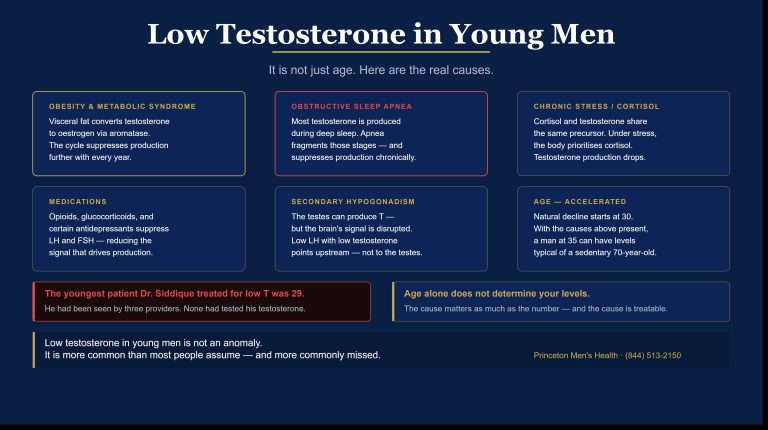
Prevalence estimates suggest that low testosterone affects a meaningful percentage of men over 45, with the rate climbing steadily with age, and increasing further in men with obesity, type 2 diabetes, or untreated sleep apnea. New Jersey’s population mirrors national trends here — this is not a rare condition, but it is a rarely fully diagnosed one.
Why most NJ evaluations miss the diagnosis
A handful of recurring gaps show up in the records patients bring me:
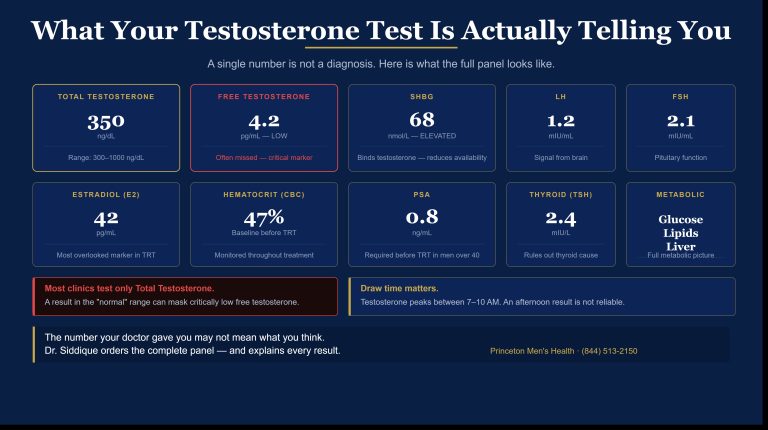
- Total testosterone only. Total testosterone measures every bit of testosterone in the blood, including the portion bound tightly to sex hormone binding globulin (SHBG) and therefore biologically unavailable to tissue. Two men with identical total testosterone can have very different free testosterone — the fraction that is actually active. Without a free testosterone value, a normal total reading can hide a genuine deficiency.
- Wrong draw timing. Testosterone follows a diurnal rhythm, peaking in the early morning and declining through the day. A level drawn in the afternoon will typically read lower than the same man’s level drawn at 8 a.m., which can produce a falsely reassuring or falsely low result depending on when the blood was taken.
- No SHBG. Without knowing SHBG, it isn’t possible to properly interpret what a total testosterone number actually means for that individual’s free hormone availability.
- No repeat confirmation. A single low or borderline reading is not a diagnosis. Testosterone levels vary day to day, and guidelines call for a second confirmatory draw before treatment begins.
The testosterone blood test page on this site walks through what a complete panel looks like in more detail.
What a proper evaluation includes
When I evaluate a patient for low testosterone, I order:
- Total and free testosterone
- SHBG
- LH and FSH, to distinguish primary (testicular) from secondary (pituitary/hypothalamic) causes
- Estradiol
- Hematocrit, since testosterone therapy can raise red blood cell counts
- PSA, as a baseline safety marker
- A metabolic panel, since insulin resistance and low testosterone frequently coexist — this overlaps meaningfully with metabolic syndrome, as described by the National Heart, Lung, and Blood Institute
- Thyroid function, since thyroid disorders can produce a symptom picture that overlaps with low testosterone
This is also where sleep is relevant: untreated sleep apnea suppresses testosterone production directly, and I screen for it as part of a complete evaluation. See sleep and men’s health for more on this connection.
What makes Princeton Men’s Health different from other NJ testosterone clinics
Two things separate this practice from many of the testosterone clinics that have opened across New Jersey in recent years. First, every patient is evaluated by me directly — Dr. Mahmood Siddique, a physician who is quadruple board-certified and has spent nearly 30 years in clinical practice, including a faculty appointment as Clinical Associate Professor at Rutgers Robert Wood Johnson Medical School. Second, treatment here is not a fixed-dose protocol applied uniformly to every patient. Doses are adjusted based on follow-up labs, symptom response, and safety markers — not a standard starting dose that stays unchanged indefinitely.
The FDA’s review following the TRAVERSE trial supports the cardiovascular safety of testosterone therapy in appropriately selected, monitored patients as non-inferior to placebo — an important distinction from earlier, less rigorous safety data, and one more reason ongoing monitoring, not a one-time prescription, is central to how I practice.
Who treats low testosterone in NJ — urologists vs. family medicine vs. men’s health
Urologists are surgical specialists whose training centers on the genitourinary system; many treat low testosterone as one part of a broader practice, often with less emphasis on the endocrine and metabolic side of hormone therapy. Family medicine physicians manage low testosterone alongside dozens of other conditions in a single visit, which limits the time available for a comprehensive hormonal workup. A dedicated men’s health practice — which is what this is — exists specifically to evaluate and manage hormonal, sexual, and metabolic health as its primary focus, with the time and lab infrastructure that requires.
The monitoring difference — why ongoing care matters
Starting testosterone replacement therapy is not a single decision made once. Follow-up labs at appropriate intervals track testosterone levels, hematocrit, and PSA, and doses are adjusted based on what those labs show combined with how you’re responding. Men who start therapy at another clinic and are never re-tested are at greater risk of either under-treatment or of drifting into supraphysiologic levels without anyone noticing. Individual results vary, and ongoing monitoring is what allows treatment to be adjusted to your specific response rather than left on autopilot.
A complete evaluation, not a single number
If you’ve been told your testosterone is “normal” based on a single total testosterone value, that may not be the full story. Testosterone replacement therapy at this practice starts with a complete evaluation, not a fixed protocol. I see patients from across the region, including men searching for a TRT clinic near me in Lawrence Township, Hamilton, and West Windsor. Contact Princeton Men’s Health to schedule a complete hormonal evaluation.
Frequently Asked Questions
What is considered low testosterone in NJ?
Low testosterone is generally defined as a total testosterone level below approximately 300 ng/dL on a morning blood draw, confirmed on a second occasion, in a man with consistent symptoms. This threshold is a starting point for evaluation, not a strict cutoff — free testosterone and SHBG are needed to interpret the full picture, and treatment decisions are individualized.
Which doctors in NJ prescribe testosterone?
Testosterone can be prescribed by urologists, endocrinologists, family medicine physicians, and dedicated men’s health physicians. Where these differ is depth of evaluation and ongoing monitoring — a men’s health practice focused specifically on hormonal and sexual health typically offers a more complete initial workup and more consistent follow-up than a general practice visit has time for.
What is the difference between total and free testosterone?
Total testosterone measures all testosterone in the blood, including the portion bound to SHBG and unavailable to tissue. Free testosterone measures only the biologically active fraction. A man can have a “normal” total testosterone level and still have a clinically low free testosterone level, which is why both values matter for an accurate diagnosis.
How do I get tested for low testosterone in New Jersey?
Testing should include a morning blood draw measuring total and free testosterone, SHBG, LH, FSH, and estradiol, with a repeat draw to confirm any low or borderline result. Contact Princeton Men’s Health to schedule a complete evaluation rather than a single total testosterone test.
What makes Princeton Men’s Health different from other NJ testosterone clinics?
Every patient is evaluated directly by Dr. Siddique, a quadruple board-certified physician with nearly 30 years of clinical experience, using a full hormonal panel rather than a single lab value. Treatment is adjusted based on follow-up labs and individual response rather than a fixed dose applied to every patient. Individual results vary.
How do I book a low testosterone evaluation?
Contact Princeton Men’s Health or call (844) 513-2150 to schedule an evaluation. The visit includes a detailed history and a comprehensive lab panel, with a treatment plan built around your specific findings.