
THE EARLY WARNING SIGN
Is Erectile Dysfunction a Warning Sign for Heart Disease?
Written by Dr. Mahmood Siddique, DO, FACP, FCCP, FAASM · Medically reviewed · Updated July 2026
For most men, erectile dysfunction feels like an embarrassing private problem. But cardiologists and men’s health physicians increasingly treat it as something else: one of the earliest visible warnings that the arteries are in trouble. In many men, ED appears years before a heart attack — which makes it worth investigating, not hiding.
Why the Penis Warns You First
Erectile dysfunction is, most often, a blood flow problem. Roughly 80% of cases are vascular — the arteries simply aren’t delivering enough blood. And the reason ED shows up early comes down to plumbing.

The penile artery is roughly half the diameter of the coronary artery — so the same plaque narrows it to a critical point sooner.
The penile artery is roughly half the diameter of the coronary artery — so the same plaque narrows it to a critical point sooner.
The artery that supplies the penis is about 2mm across. The artery that supplies your heart — the coronary artery — is about 4mm. Plaque doesn’t form in one place and spare another; atherosclerosis is a whole-body process. But because the penile artery is so much narrower to begin with, the same amount of plaque restricts it to a critical point first.
In other words, the penis is the early warning system. It reports a circulation problem while the larger arteries are still coping. Dr. Siddique calls erectile dysfunction the canary in the coal mine for coronary heart disease.
The Five-Year Head Start
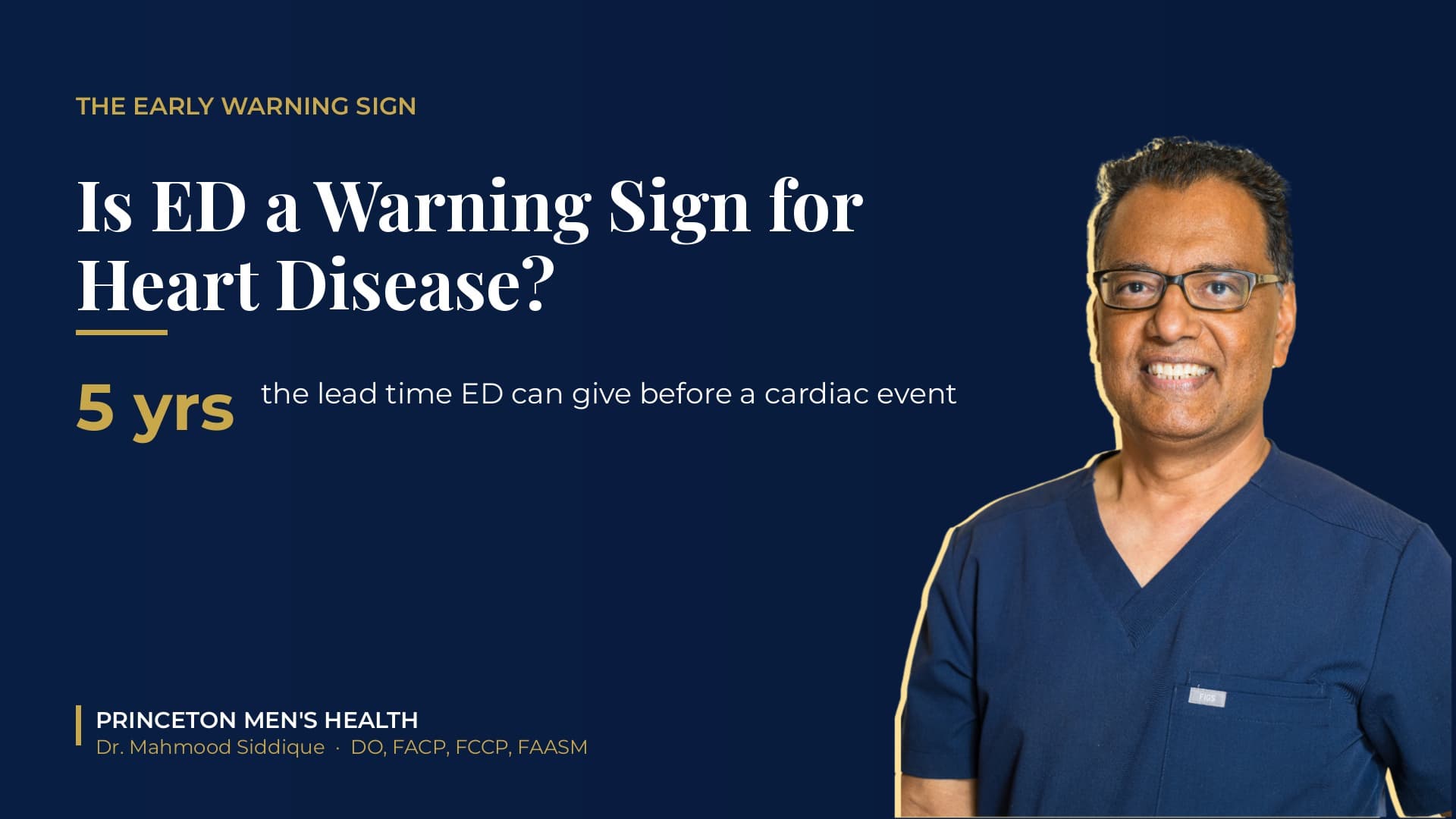
This isn’t a loose analogy — it’s a documented, measurable window. Research consistently shows that in men whose ED has a vascular cause, erectile symptoms typically precede a significant cardiac event by around five years.
That is a remarkable thing to have: a five-year head start to find and address a problem before it reaches the heart. Most warning signs of heart disease arrive with little notice. This one arrives early, and it arrives in a form that’s easy to notice.
What ED Can Be Telling You
Because ED and heart disease share the same underlying causes, erectile difficulty can be an early flag for conditions that often haven’t been diagnosed yet:
Atherosclerosis — plaque narrowing the arteries throughout the body.
High blood pressure — which damages and stiffens the vessels.
Diabetes or insulin resistance — a major driver of vascular damage.
High cholesterol — feeding plaque formation.
Metabolic syndrome — the cluster of abdominal weight, blood pressure, and blood sugar problems.
None of this means every man with ED has heart disease. It means ED is a reason to look — to check the things that are quietly worsening in the background.
Why This Changes How ED Should Be Treated
This is the core reason to see a physician rather than order pills online. A prescription treats the symptom. A proper evaluation asks why the blood flow dropped in the first place — and whether that same process is affecting the heart.
Dr. Siddique is board-certified in Internal Medicine and evaluates ED in that fuller context: not just restoring erectile function, but identifying and addressing the vascular and metabolic factors behind it. For many men, treating those factors improves both their erections and their long-term cardiovascular health at the same time.
Frequently Asked Questions
Not necessarily — but it’s a reason to check. Because most ED is vascular and shares the same causes as heart disease, erectile dysfunction can be an early sign that the arteries are affected. It often appears before other symptoms, which is why it’s worth having evaluated by a physician rather than ignored.
In men whose ED has a vascular cause, erectile symptoms typically precede a significant cardiac event by about five years. That window is one of the main reasons physicians take ED seriously as an early warning sign.
The artery supplying the penis is roughly half the diameter of the coronary artery. Because it’s so much narrower to begin with, the same plaque restricts it to a critical point sooner — so erectile difficulty appears while the larger arteries are still coping.
Often, yes. Because ED and heart disease share causes — high blood pressure, high cholesterol, diabetes, metabolic syndrome — addressing those factors can improve both erectile function and cardiovascular health. This is why a physician evaluation looks beyond the symptom.
Start with a physician who will evaluate the underlying cause. Dr. Siddique is board-certified in Internal Medicine and assesses ED in its full vascular and metabolic context, and will refer to cardiology if the evaluation warrants it.
Related Reading
- Why Viagra stopped working for you — and what actually comes next →
- Why you can get hard but can’t stay hard (venous leak) →
- Erectile Dysfunction Treatment in Princeton, NJ →
Treat the Symptom — and Find the Cause
Erectile dysfunction is worth listening to. Dr. Siddique will evaluate what's driving it and check the vascular and metabolic factors that matter for your long-term health.

ABOUT THE AUTHOR
Dr. Mahmood Siddique, DO, FACP, FCCP, FAASM
Dr. Siddique is a quadruple board-certified physician with nearly 30 years in practice and a Clinical Associate Professor of Medicine at Rutgers Robert Wood Johnson Medical School. He leads Princeton Men’s Health in Lawrence Township, NJ. Read more about Dr. Siddique.