
ERECTILE DYSFUNCTION EXPLAINED
Why You Can Get Hard, But Can’t Stay Hard
Written by Dr. Mahmood Siddique, DO, FACP, FCCP, FAASM · Medically reviewed · Updated July 2026
It is one of the most common things men describe, and one of the least talked about: the erection starts fine, then fades before sex is over. It is not in your head, and it is not a performance problem. It usually has a specific physical cause with a name — venous leak — and understanding it is the first step to treating it. Venous leak is just one of several possibilities for what causes erectile dysfunction, and identifying the right one matters.
How an Erection Actually Holds
An erection is a pressure system. When you become aroused, blood rushes into the two chambers that run the length of the penis, the corpora cavernosa. As they fill, the veins that would normally drain that blood are pressed shut — sealing the pressure in. That seal is what keeps you hard.
Dr. Siddique describes it simply: the more blood flows in, the more tightly those venous valves close. Full inflow, valves sealed, pressure held — that is a firm erection, maintained until climax.
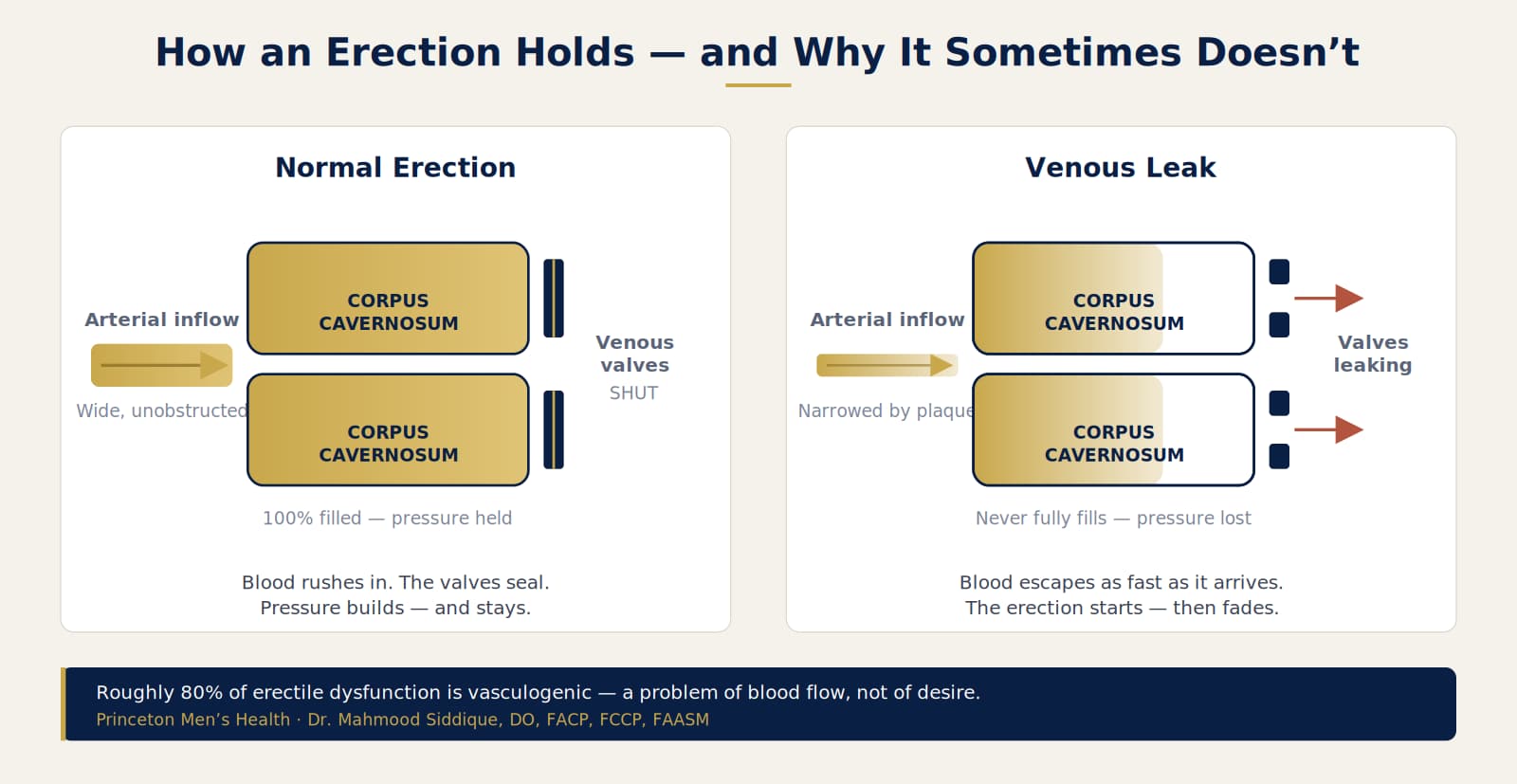
Left: a normal erection — full arterial inflow, venous valves sealed. Right: venous leak — reduced inflow, valves left partly open, pressure escaping.
What Goes Wrong in Venous Leak
Now picture the same system with less blood coming in. If plaque has narrowed the artery, you are no longer delivering full inflow — maybe only a trickle. And here is the problem: those venous valves only seal properly when inflow is strong. With weak inflow, the valves never fully close. Blood escapes from the chambers almost as fast as it arrives.
Dr. Siddique calls it the leaky bucket. You are pouring water in, but the level never rises, because it is draining out at the same time. That is why the erection begins — there is enough inflow to start — but fades, because the pressure cannot be held. The technical name is veno-occlusive dysfunction. Most men just know it as “I can’t stay hard.”
What Can Be Done About It
Because the root problem is blood flow, effective treatment focuses on restoring it rather than working around it:
Focused shockwave therapy — low-intensity acoustic waves used to stimulate new blood vessel growth, improving inflow at the source.
The P-Shot — platelet-rich plasma from your own blood, used to support vascular and tissue health.
Injection therapy (Trimix) — works through a different pathway than oral medication and can produce rigidity where pills no longer do.
Treating the underlying cause — plaque, low testosterone, and undiagnosed sleep apnea all reduce the inflow that venous leak depends on.
The right approach depends on how significant the leak is and what is driving it — which is why an evaluation, not a guess, comes first. Dr. Siddique will tell you what is realistic in your case.
Frequently Asked Questions
It usually means blood is entering the penis but not staying there — a condition called venous leak, or veno-occlusive dysfunction. The veins that should seal to trap blood aren’t closing fully, so the erection starts but can’t be maintained. It’s a physical, vascular issue, not a psychological one.
Not necessarily. Because venous leak is usually driven by reduced arterial inflow, treatments that restore blood flow — such as focused shockwave therapy — can improve the ability to maintain an erection. The right approach depends on the cause and severity, which is why an evaluation matters.
Viagra and Cialis help blood get into the penis, but they can’t stop it leaking back out. If the underlying problem is venous leak caused by poor inflow, oral medication often produces a partial or short-lived result. This is one of the most common reasons men find the pills disappointing.
Yes, and it’s a useful clue. If you wake with erections or can maintain one alone but not during sex, the mechanism works — it simply can’t hold pressure under full demand. That pattern points toward a blood-flow issue rather than a psychological one, and it’s worth having evaluated.
Most often reduced arterial inflow — from plaque buildup, aging blood vessels, or declining nitric oxide. Low testosterone, diabetes, high blood pressure, and untreated sleep apnea all contribute. Because these are frequently the same factors behind heart disease, venous leak is worth taking seriously beyond the bedroom.
Find Out What’s Actually Going On
If your erection starts but doesn’t hold, the cause can be identified. Dr. Siddique will evaluate the blood flow and tell you honestly what will help in your case.

ABOUT THE AUTHOR
Dr. Mahmood Siddique, DO, FACP, FCCP, FAASM
Dr. Siddique is a quadruple board-certified physician with nearly 30 years in practice and a Clinical Associate Professor of Medicine at Rutgers Robert Wood Johnson Medical School. He leads Princeton Men’s Health in Lawrence Township, NJ. Read more about Dr. Siddique.