
WHEN THE PILLS STOP WORKING
Why Viagra Stopped Working for You — and What Actually Comes Next
Written by Dr. Mahmood Siddique, DO, FACP, FCCP, FAASM · Medically reviewed · Updated July 2026
If Viagra or Cialis worked at first and then slowly stopped, you have not “gotten immune” to it, and you are not imagining it. The medication is doing exactly what it always did — but it can only work with something your body may be running low on. Here is what is actually happening, explained by Dr. Siddique. It helps to understand the underlying causes of erectile dysfunction, since that context explains why medication alone sometimes isn’t enough.
What Viagra and Cialis Actually Do
When you become aroused, the nerve endings in the penis release nitric oxide. Nitric oxide relaxes the smooth muscle in your arteries, they widen, and blood rushes in. That is an erection — a plumbing event triggered by a chemical signal.
Your body is constantly breaking that nitric oxide back down through an enzyme called PDE5. Dr. Siddique describes PDE5 as a set of Pac-Men, gobbling up your nitric oxide as fast as it appears.
Viagra and Cialis do not add nitric oxide. They freeze the Pac-Men. By blocking PDE5, they stop your nitric oxide being broken down so quickly, so more of it stays available and your arteries stay open longer. That is the whole mechanism — and it explains everything about why the pills sometimes stop working.
The Reason They Stop Working
Here is the catch. The pills can only preserve the nitric oxide you already produce. They cannot manufacture more. And your nitric oxide reserve falls steadily with age.
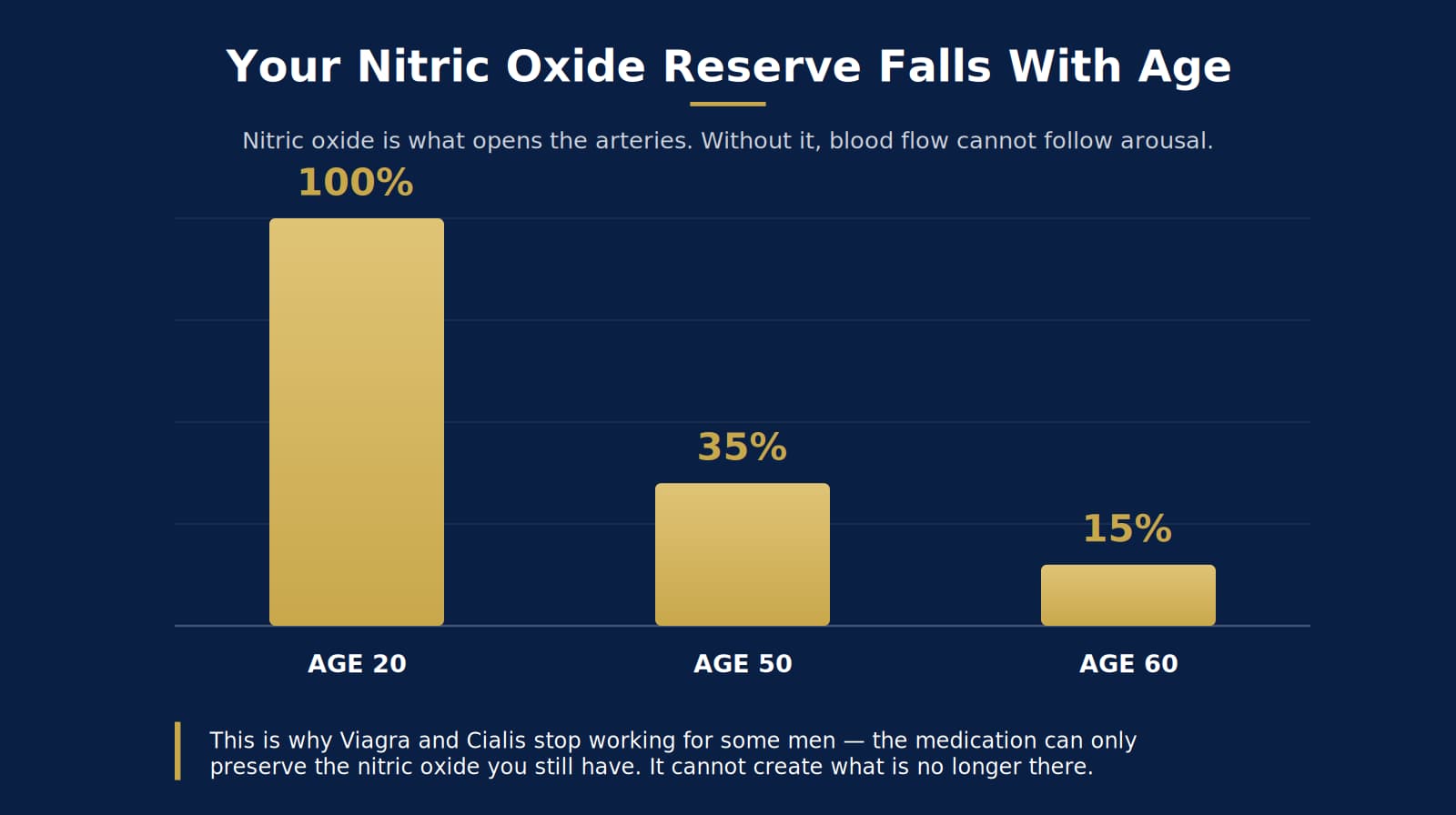
Nitric oxide reserve declines with age — from a full reserve at 20 to roughly 15% by 60.
If the pills have stopped working, the goal changes. Instead of preserving the blood flow you have, the aim becomes restoring blood flow at the source. Depending on what is actually driving the problem, that can mean:
Focused shockwave therapy — low-intensity acoustic waves used to stimulate new blood vessel growth in the tissue itself.
Injection therapy (Trimix) — a physician-prescribed option that works through a different pathway than oral medication, and is often effective for men who no longer respond to pills.
The P-Shot — platelet-rich plasma from your own blood, used to support tissue and vascular health.
Treating the underlying cause — low testosterone, a metabolic issue, or undiagnosed sleep apnea can all suppress blood flow. Addressing these often matters more than any single procedure.
The right answer depends entirely on why your pills stopped working — which is something that has to be evaluated, not guessed. Dr. Siddique will tell you which of these is actually relevant to you, and which is not.
Frequently Asked Questions
Viagra doesn’t lose its effect over time in the way a tolerance builds. What usually changes is you. The medication preserves your nitric oxide, but your nitric oxide reserve declines with age and plaque narrows the arteries. Over time there is simply less for the medication to work with, so the same dose produces a weaker result.
Sometimes, but there is a ceiling. Once you are a true PDE5 non-responder, increasing the dose rarely helps and increases side effects, because the medication still can’t create blood flow that isn’t there. This is the point at which a physician evaluation matters, rather than simply taking more.
It means oral ED medications like Viagra, Cialis, sildenafil, or tadalafil no longer produce a usable erection for you. It is common, it is not a dead end, and it usually points to a specific underlying cause — most often reduced blood flow — that can be identified and treated.
Options that restore blood flow rather than preserve it — including focused shockwave therapy, injection therapy such as Trimix, and platelet-rich plasma (the P-Shot) — often work for men who no longer respond to pills. Treating an underlying cause such as low testosterone or sleep apnea is frequently part of the answer.
Yes — and not only for the ED. Erectile dysfunction is often an early warning sign of a vascular or metabolic problem that hasn’t been diagnosed yet. A physician evaluation looks for that cause rather than simply prescribing a stronger pill.
Related Reading
- Why you can get hard but can’t stay hard: understanding venous leak
- Is erectile dysfunction an early warning sign of heart disease?
- Erectile Dysfunction Treatment in Princeton, NJ
Find Out Why — From a Physician
If oral medication has stopped working, the next step is understanding why. Dr. Siddique will evaluate the cause and tell you honestly what will and won’t help in your case.

ABOUT THE AUTHOR
Dr. Mahmood Siddique, DO, FACP, FCCP, FAASM
Dr. Siddique is a quadruple board-certified physician with nearly 30 years in practice and a Clinical Associate Professor of Medicine at Rutgers Robert Wood Johnson Medical School. He leads Princeton Men’s Health in Lawrence Township, NJ. Read more about Dr. Siddique.