Testosterone and Heart Health — What the 2023 TRAVERSE Trial Actually Found
The Question Patients Ask Me Most
After thirty-one years of practicing internal medicine, I have learned exactly which question comes first when a patient sits down to discuss testosterone therapy. It is rarely about dosing, cost, or how quickly he will feel a difference. It is almost always some version of: “Doctor, is this going to hurt my heart?” That question deserves a direct, evidence-based answer, not a reassurance built on marketing language. For over a decade, the honest answer was clouded by conflicting, imperfect data. In 2023, we finally received a large, carefully designed trial built specifically to answer it. I want to walk you through what that trial, known as TRAVERSE, actually found — and just as importantly, what it did not find.
Why the Fear Existed
The concern around testosterone therapy and cardiovascular risk did not appear out of nowhere. In the early 2010s, several observational studies raised alarms suggesting testosterone therapy might increase the risk of heart attack and stroke in older men. These studies had real limitations. Some were retrospective chart reviews rather than randomized trials. Some failed to separate men who actually achieved normal testosterone levels on therapy from those who did not. Others pooled data from mixed populations in ways that produced misleading signals within certain subgroups. The methodology mattered, but the headlines that followed did not always reflect that nuance.
In response, the FDA required manufacturers to add cardiovascular warning language to testosterone products and mandated a large postmarketing safety trial to settle the question with better evidence. That mandate is what eventually produced TRAVERSE. It took years to design, enroll, and complete, but it gave us something the earlier studies never could: a prospective, randomized, placebo-controlled answer in exactly the population most affected by the original concern.
What TRAVERSE Actually Studied and Found
Study Design
The Testosterone Replacement Therapy for Assessment of Long-term Vascular Events and Efficacy Response in Hypogonadal Men trial, known as TRAVERSE, enrolled more than 5,000 men between the ages of 45 and 80. Every participant had documented low testosterone along with either existing cardiovascular disease or significant cardiovascular risk factors. This was intentional: the researchers wanted to study the population where the original safety concerns were loudest, not a low-risk group that would tell us little. Men were randomly assigned to receive either testosterone gel or a placebo gel and were followed for a median of about two years, with major adverse cardiac events — heart attack, stroke, and cardiovascular death — tracked as the primary outcome.
Key Findings
The trial results were published in the New England Journal of Medicine (read the full TRAVERSE trial results). The headline finding was this: testosterone therapy did not increase the rate of major adverse cardiac events compared with placebo, even in this higher-risk population. For a question that had lingered unresolved for more than ten years, that is a meaningful result, and it is one I take seriously in how I counsel patients. But the way this finding gets summarized in casual conversation and in some media coverage is not always precise, and precision is what patients deserve when the topic is their heart.
What Non-Inferiority Means in Plain Language
TRAVERSE was designed as a non-inferiority trial. That is a specific statistical framework, and it is not interchangeable with a claim of benefit. A non-inferiority design sets out to answer one narrow question: is testosterone therapy “not meaningfully worse” than placebo for cardiovascular safety? The data supported that conclusion. It does not mean testosterone therapy was shown to improve heart health, reduce cardiovascular risk, or prevent heart attacks and strokes. Those are different questions that this trial was not designed to answer.
I am deliberate about this distinction in my own practice, and I would encourage you to be just as deliberate if you encounter this trial referenced elsewhere. TRAVERSE answered a safety question. It did not answer an efficacy question about cardiovascular protection, and I will not describe it to you as though it did.
Who This Matters Most For
This finding carries the most practical weight for a specific group of patients I see regularly in this practice: men with documented low testosterone who also carry meaningful cardiovascular risk factors. That includes men with:
- Type 2 diabetes — insulin resistance and low testosterone frequently occur together, and both influence cardiovascular risk independently of one another.
- Hypertension — well-controlled blood pressure remains a requirement before and during therapy, not a reason to avoid the conversation entirely.
- Obesity or metabolic syndrome — a cluster of risk factors, including central obesity, elevated triglycerides, low HDL, and elevated blood pressure and fasting glucose, that the National Heart, Lung, and Blood Institute has linked to significant cardiovascular risk, and one that overlaps often with low testosterone.
- A prior cardiac event — this is precisely the population TRAVERSE was designed to study, and the non-inferiority finding applies most directly here.
For these men, hesitation around testosterone therapy has historically been loudest, and it is exactly this group where TRAVERSE offers the most direct reassurance about safety. That reassurance does not eliminate the need for careful, ongoing monitoring. What it does is shift the conversation from whether we can responsibly consider therapy at all, to how we manage it carefully over time.
How I Monitor Cardiovascular Markers on TRT
My board certification in internal medicine, along with pulmonary and critical care medicine, shapes how I approach testosterone therapy. I do not view it in isolation from a man’s broader cardiovascular and metabolic health. That overlap is a central part of how I practice.
Before Starting Therapy
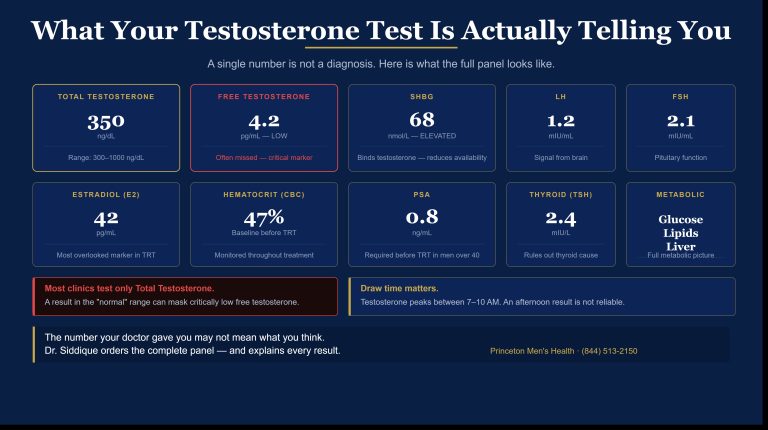
Before any patient begins treatment, I review baseline hematocrit, a full lipid panel, fasting glucose or HbA1c, blood pressure, and a detailed cardiovascular history. If something in that picture needs attention first, we address it first.
Ongoing Monitoring
- Hematocrit — testosterone stimulates red blood cell production, and an elevated hematocrit increases blood viscosity, which is a genuine safety consideration that requires monitoring and, occasionally, dose adjustment or blood donation.
- Blood pressure — checked at baseline and at follow-up visits, since fluid retention can occur in some patients.
- Lipid panel — reviewed periodically as part of the full cardiovascular picture, not testosterone levels in isolation.
- Fasting glucose and HbA1c — particularly relevant given how frequently low testosterone and insulin resistance occur together.
- Symptom review — chest pain, shortness of breath, or new exercise intolerance are addressed directly and promptly at every visit.
This is the same rigor I apply to any chronic therapy with cardiovascular overlap. Individual results vary, and this monitoring is not a formality. It is how therapy stays safe over years, not just months.
Closing Thoughts
The TRAVERSE trial gave us something we did not have before: a large, randomized, well-controlled answer to a question that had lingered unresolved for more than a decade. Testosterone therapy did not increase major adverse cardiac events in a population selected specifically for elevated cardiovascular risk. That is a genuinely reassuring finding, and I share it with my patients accordingly. It is not a claim that testosterone therapy improves heart health, and I will not present it that way in this practice.
If you have low testosterone and also carry cardiovascular risk factors, this is exactly the conversation we should have together, with your labs and your history in front of us. You can learn more about how I approach treatment on my testosterone therapy page, or read more about finding a TRT clinic near you in New Jersey. I see patients from Lawrence Township, Hamilton, and West Windsor, and I welcome the opportunity to review your specific cardiovascular history with you directly. Contact my office to schedule a consultation.
According to the 2023 TRAVERSE trial, testosterone therapy did not increase the rate of major adverse cardiac events, including heart attack, stroke, and cardiovascular death, compared with placebo in men with low testosterone and elevated cardiovascular risk. This was a non-inferiority finding, meaning the trial showed the therapy was not meaningfully worse than placebo for cardiovascular safety. It is not evidence that testosterone therapy improves heart health. Individual results vary, and any decision to start therapy should follow a full review of your personal cardiovascular history.
A non-inferiority trial is designed to show that a treatment is not meaningfully worse than a comparison group for a specific outcome. TRAVERSE was designed this way for cardiovascular safety, and it answered whether testosterone therapy was as safe as placebo regarding major cardiac events. It was not designed, and should not be interpreted, as proof that testosterone therapy provides a cardiovascular benefit or reduces cardiovascular risk.
TRAVERSE enrolled more than 5,000 men between ages 45 and 80 with documented low testosterone who also had existing cardiovascular disease or significant cardiovascular risk factors. This population was chosen specifically because it represented the group where earlier cardiovascular safety concerns were strongest, making the findings especially relevant to men with diabetes, hypertension, or a prior cardiac event.
These conditions do not automatically exclude you from testosterone therapy, but they do require careful evaluation and ongoing monitoring. I review your full cardiovascular and metabolic history, including blood pressure control and glucose management, before making any recommendation, and I continue monitoring these markers throughout treatment.
I monitor hematocrit, blood pressure, a full lipid panel, and fasting glucose or HbA1c at baseline and at regular intervals during treatment. Hematocrit is particularly important, since testosterone can stimulate red blood cell production, and an elevated hematocrit increases blood viscosity. This monitoring continues for as long as you remain on therapy.
No. TRAVERSE showed that testosterone therapy did not increase major adverse cardiac events compared with placebo in the population studied, which is reassuring, but no medical therapy is entirely without risk for every individual. This is why ongoing monitoring and an honest conversation about your personal cardiovascular history remain an essential part of care in my practice.