
Testosterone Replacement Therapy New Jersey
Testosterone Replacement Therapy New Jersey | Princeton Men’s Health
Confirmed with proper bloodwork. Directed by a quadruple board-certified physician.
If you are searching for testosterone replacement therapy in New Jersey, Princeton Men’s Health offers something most clinics cannot: a physician-led program overseen entirely by Dr. Mahmood Siddique, DO — quadruple board-certified and a Clinical Associate Professor at Rutgers Robert Wood Johnson Medical School. Every diagnosis begins with lab work. Every treatment plan is built around your results, your symptoms, and your goals. No cookie-cutter protocols. No one-size-fits-all dosing.

What Is Testosterone Replacement Therapy — and Do You Need It?
Testosterone replacement therapy in New Jersey is not one-size-fits-all — and at Princeton Men’s Health, it never is. Dr. Mahmood Siddique, DO, FACP, FCCP, FAASM — quadruple board-certified and a Clinical Associate Professor at Rutgers Robert Wood Johnson Medical School — oversees every patient personally, from your first consultation through ongoing monitoring. Every diagnosis begins with lab work. Every treatment plan is built around your results, your symptoms, and your goals.
Signs of Low Testosterone in Men
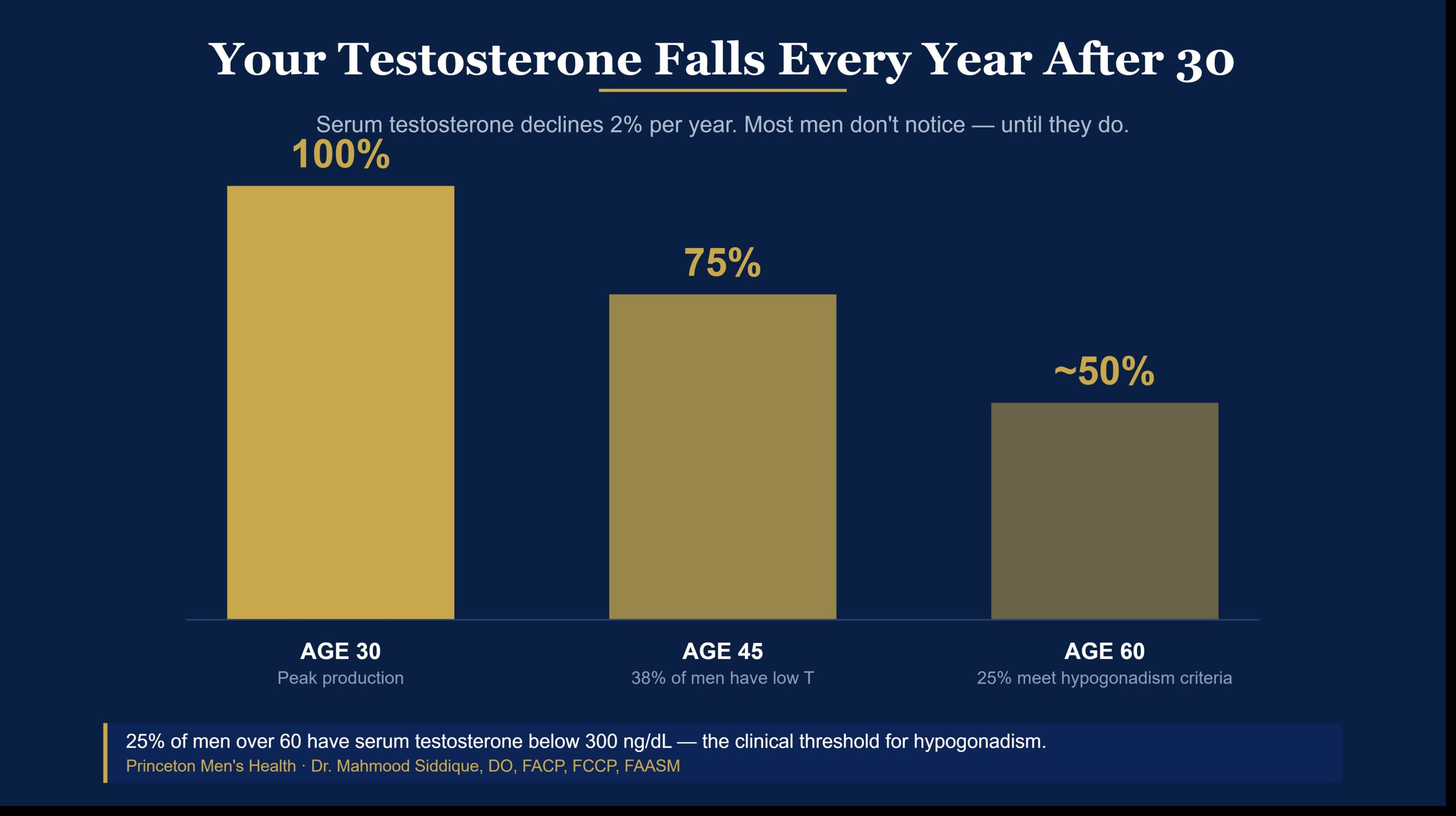
Testosterone begins declining at roughly 2% per year after age 30. By your mid-40s, the cumulative effect becomes impossible to ignore. By age 60, most men have lost approximately 25% of their peak testosterone — and 25% will meet the clinical threshold for hypogonadism, defined as a serum level below 300 ng/dL.
Common signs that your testosterone may be low:
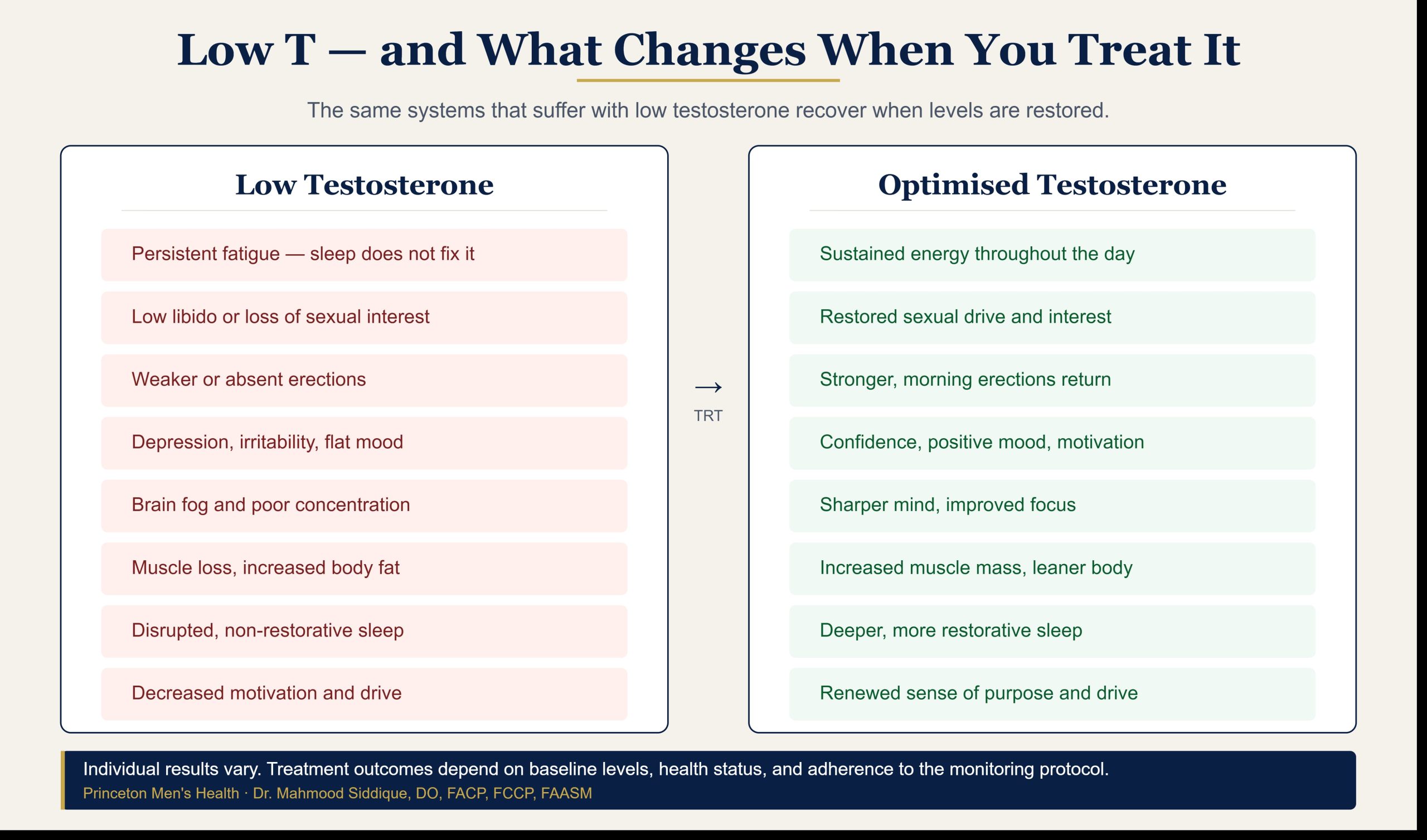
- Persistent fatigue that sleep does not fix
- Declining libido or loss of interest in sex
- Weaker or less frequent erections
- Loss of muscle mass despite regular exercise
- Increasing belly fat, particularly around the midsection
- Depression, irritability, or flattened mood
- Brain fog, poor concentration, or memory lapses
- Disrupted or non-restorative sleep
- Decreased motivation and drive
These symptoms rarely arrive alone. Most men present with three, four, or five at once — which is why Dr. Siddique evaluates the full clinical picture, not a single lab value in isolation.
From Dr. Siddique
Why Your Testosterone Is Falling
Testosterone declines roughly 2% every year after the age of 30. By 60, most men have lost about a quarter of what they had — and 38% of men over 45 have levels low enough to matter. Dr. Siddique explains what is actually happening, why it tracks so closely with fatigue, weight gain, poor sleep and low libido, and why a 2023 study in the New England Journal of Medicine found that men aged 45–80 with low testosterone frequently carried multiple cardiovascular risk factors alongside it.
Dr. Mahmood Siddique, DO, FACP, FCCP, FAASM — Clinical Associate Professor of Medicine, Rutgers Robert Wood Johnson Medical School.
Treatment Options
Three Ways to Restore Your Testosterone
Dr. Siddique selects the right delivery method based on your lab results, lifestyle, and personal preference. There is no one-size-fits-all protocol here.
Testosterone gel
Daily application
Benefits
- ✓Non-invasive — no needles or procedures
- ✓Dose easily adjusted as levels stabilise
- ✓Most widely prescribed form of TRT
Considerations
- △Requires a consistent daily routine
- △Avoid skin-to-skin contact after application
Weekly injections
Cypionate or enanthate
Benefits
- ✓Precise, controlled dosing every week
- ✓Decades of clinical safety data
- ✓Self-administration option available
Considerations
- △Weekly schedule to maintain
- △Levels peak mid-week, trough before next dose
Pellet therapy
10–12 pellets · lasts 4–5 months
Benefits
- ✓Steady, stable levels — no peaks or troughs
- ✓No daily routine or weekly injections
- ✓Mirrors your body’s natural release rhythm
- ✓One brief procedure every 4–5 months
Considerations
- △Minor in-office insertion procedure required
What to Expect From Testosterone Replacement Therapy
Regardless of which delivery method you choose, Dr. Siddique monitors your progress at regular intervals. Follow-up labs include serum testosterone, estradiol, and a complete blood count. Testosterone stimulates red blood cell production, so hematocrit is checked periodically — and if levels rise above the healthy range, Dr. Siddique may recommend donating blood to bring them back into balance. This is a normal, manageable aspect of TRT, not a reason to avoid treatment.
Patient Story
“My Only Regret Is That I Didn’t Start Sooner.”
Tony came to us frustrated. He couldn’t lose weight no matter what he tried. His energy was gone, his stamina had collapsed, and a persistent brain fog made it hard to focus through a normal day.
Rather than treat one symptom in isolation, Dr. Siddique addressed the whole system — testosterone therapy alongside nutrition and body composition analysis. A year on: 35 pounds lost with muscle preserved, workout recovery cut in half, the fog lifted, and his pre-diabetic markers back to normal range.
Individual results vary. Shared with patient consent.
Transparent Pricing & Discreet, Private Care
Testosterone therapy at Princeton Men’s Health is offered on a straightforward self-pay basis with clear, upfront pricing — no surprise bills and no long-term membership required. Your initial consultation and diagnostic lab work may be eligible to bill to your insurance; we’ll check your coverage for those before your visit. Everything is handled privately and discreetly, from your first call to ongoing care.
Serving Princeton, Lawrence Township, Hamilton & West Windsor
Our clinic is located at 31 East Darrah Lane, Lawrence Township, NJ 08648 — convenient to Princeton, Lawrenceville, Hamilton, West Windsor, Ewing, and Pennington. If you’ve been searching for men’s testosterone replacement therapy near Princeton, we’re a short drive away.
Frequently Asked Questions
Princeton Men’s Health provides testosterone replacement therapy in New Jersey from our clinic at 31 East Darrah Lane, Lawrence Township — minutes from Princeton, Hamilton, and West Windsor. Dr. Siddique sees patients by appointment. Call (844) 513-2150 or use the booking form to get started.
The only way to know for certain is a blood test. Dr. Siddique evaluates serum testosterone alongside your symptoms, health history, and other relevant markers. Many men seeking testosterone replacement therapy in New Jersey discover their levels are below the clinical threshold of 300 ng/dL — but even men testing in the “normal” range can benefit if their symptoms are significant and other causes have been ruled out.
When properly prescribed and monitored, testosterone replacement therapy is safe for the vast majority of men. Dr. Siddique follows evidence-based protocols informed by nearly 30 years of clinical experience and current research, including data from the landmark 2023 TRAVERSE trial published in the New England Journal of Medicine. Regular monitoring ensures your treatment stays optimised and your health markers remain in range.
Many men notice improvements in energy, mood, and libido within the first several weeks, with fuller benefits over a few months. Your plan is monitored and adjusted along the way.
Call (844) 513-2150 or book a consultation online. We’ll confirm your labs, review your symptoms, and build a plan that’s right for you.
Start Testosterone Replacement Therapy in New Jersey
Book a confidential consultation with Dr. Siddique today.
Princeton Men’s Health is one of the few physician-led practices offering testosterone replacement therapy in New Jersey with full in-house laboratory evaluation, personalised treatment planning, and ongoing follow-up care. If you have been told your levels are “normal” but you still do not feel like yourself — that conversation deserves a real answer.